This article is part of the continuing series, Inheritance and Influence: Women of the Promise.
The Apostle Paul spent three months in Greece (Corinth) in the winter of 56-57 CE (Acts 20:2-3). He stayed in the home of a man named Gaius while dictating his thoughts to a scribe, Tertius. In this place and in this setting, the Apostle wrote a masterpiece of theology that we now call the book of Romans.
The Apostle Paul had never visited Rome, yet he recognized its importance in the Gentile world. The Apostle, while in Greece, made plans to travel to Jerusalem to take relief to the struggling saints who were also his natural countrymen. He had a great desire to provide this aid but knew he would face hostile elements in Judea. Therefore, he felt a heightened urgency to write the letter and have it delivered to the believers in Rome. The Apostle Paul wrote the letter on a single papyrus scroll, and a trusted messenger would transport it from Greece to Rome. The trusted messenger was a woman named Phoebe.
“I commend unto you Phebe our sister, which is a servant of the church which is at Cenchrea: That ye receive her in the Lord, as becometh saints, and that ye assist her in whatsoever business she hath need of you: for she hath been a succourer of many, and of myself also.”
Romans 16:1-2
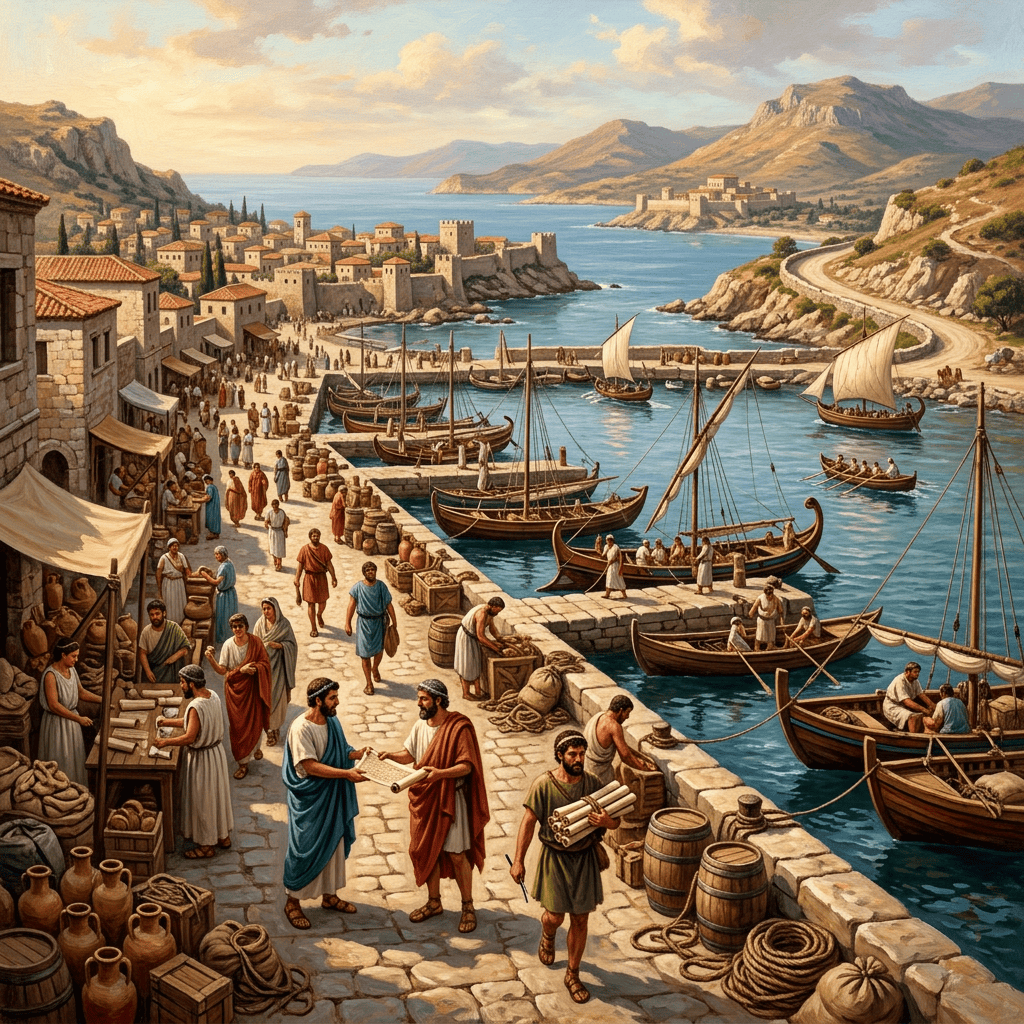
Cenchrea was a bustling seaport town. Although not geographically part of Corinth, Cenchrea was politically under Corinth’s control and served as its eastern seaport. Cenchrea was a gateway for maritime trade and movement across the Aegean and Ionian Seas. Phoebe made her home in Cenchrea and was therefore very familiar with maritime activities. Phoebe was a dedicated member of the house church in Cenchrea, and the verse quoted above tells us much about Phoebe from the Apostle Paul’s perspective.
First, Paul called her a sister in Christ. This term marks her as a believer and one who is seeking to know the things of Jesus Christ. Second, he calls her a servant (Diakonos), meaning that she has taken on active, leadership roles within the congregation. This is important because it demonstrates that Phoebe had proven to the Apostle Paul that she was willing to sacrifice herself to the greater cause of the truth of Jesus Christ. Finally, he refers to her as a succourer (prostatis) or one who is a legal defender, wealthy benefactor, and financial sponsor for the church. Phoebe was not only part of the congregation in Cenchrea, but also sheltered and funded it. The congregation in Cenchrea likely met in Phoebe’s home. Her dedication and public service to the truth of Jesus Christ were evident and recognized by those around her, including the Apostle Paul.
The nature of long-distance communication in the Roman Empire will transform Phoebe from a dedicated local disciple into a woman of inheritance and influence. The Roman Empire maintained an official postal service; however, that service was closed to private citizens and reserved for government dispatches and military orders. Private correspondence, over any distance, relied entirely on trusted personal friends or commercial travelers. The letter from the Apostle Paul in Corinth to the saints in Rome required a personal transport. The journey from Cenchrea to Rome involved hazardous sea passages and travel along the Via Appia (a Roman highway running north to south across what is today Italy). The Apostle Paul himself described the perils of this type of travel.
“Thrice was I beaten with rods, once was I stoned, thrice I suffered shipwreck, a night and a day I have been in the deep; In journeyings often, in perils of waters, in perils of robbers, in perils by mine own countrymen, in perils by the heathen, in perils in the city, in perils in the wilderness, in perils in the sea, in perils among false brethren;”
2 Corinthians 11:25-26
Phoebe bore responsibility for caring for the papyrus scroll under all these conditions. We must not lose sight of the providence of God that was with Phoebe on this journey. However, while in hindsight we can see the Holy Spirit preserving what is now the book of Romans, when Phoebe was transporting the scroll, all she knew was that the trusted Apostle had felt an urgent need to write these words and deliver them to distant saints. Those words were in her care.
Phoebe must have felt tremendous relief when she arrived in Rome, and she delivered the papyrus scroll safely to its destination. However, Phoebe had further work to perform. In Greco-Roman rhetoric, a letter-bearer was the author’s living voice and official representation. Phoebe’s charge was to read the scroll to the multiple house churches in Rome. She had to be thoroughly familiar with the text to unroll the scroll and read it aloud smoothly with the Apostle Paul’s intended inflection, emotion, and rhetorical emphasis. When members of the congregations had questions about difficult passages, Phoebe was the one there to answer them and explain their meaning from the Apostle. She had spent considerable time with the Apostle Paul, learning what he taught, in preparation for her role upon her arrival in Rome.
The 16th chapter of Romans is vital to knowing the story of Phoebe. However, its structure over the first sixteen verses is difficult for modern Bible students. The verses contain many names, most of which are unfamiliar, of people we neither understand nor know their history. However, this section of the text was of great importance for the believers who heard this letter read by Phoebe. The early church, in Rome and in other locations, was not comprised of large, centralized locations. Rather, many small house churches existed without direct contact with one another. As Phoebe read this series of greetings in various house churches, it validated local leaders, connected independent assemblies, and strengthened the cause of Jesus Christ.
Among those mentioned in the 16th chapter are many dedicated women. In verses 3-5, the Apostle specifically mentions Priscilla and her husband Aquila, who had given dedicated service to the Apostle and the Lord. Now, these two dedicated women, Phoebe and Priscilla, are being acquainted with each other. It is a momentous historical scene where Phoebe from Cenchrea meets Priscilla in Rome, uniting their efforts to preserve and spread the Gospel in the imperial capital.
Long before councils, printing presses, or other modern inventions, the Gospel moved through dedicated, courageous individuals who carried the Word across perilous landscapes. Today, when we read the book of Romans, we read a text that reached history through the providence of God and the faithfulness of a woman from Cenchrea. This is the inheritance and influence of Phoebe, a woman of the promise.


Leave a Reply