The sermon is part of the continuing series, Inheritance & Influence: Women of the Promise.
The sermon, by its nature, provides the bird’s-eye view of Scripture and its meaning. Sermons lay out the theological framework, the cultural context, and the clear call to discipleship. In contrast, the written Bible study allows us to zoom in on the quiet, intricate details of the text. It allows the Bible student to read, reread, and analyze the passages of Scripture differently than by listening to a sermon. In our study of The Unnamed Collective, the Sunday sermon honored the faithful early-morning labor of the women who stepped into the dark, carrying burial spices. Yet, when we examine the Gospel texts themselves, a striking literary contrast emerges. Matthew and Mark offer distinct accounts of that morning. The contrast between the two is the pacing of the events: one brings the narrative to a sudden, trembling halt, while the other launches it into immediate motion. These differences do not weaken the truth of the accounts; rather, when placed side by side, they provide the Bible student with a blueprint for how the human soul encounters the living God.
“He is not here: for he is risen, as he said. Come, see the place where the Lord lay.”
Matthew 28:6
Matthew and Mark record the same transformative morning for The Unnamed Collective and the New Testament church. Mark, in his account, deliberately slows his narrative down to force the reader to experience the shock of holy terror. Meanwhile, Matthew accelerates his account to show the energy of gospel obedience. Let’s begin by examining Mark’s account.
“And they went out quickly, and fled from the sepulchre; for they trembled and were amazed: neither said they any thing to any man; for they were afraid.”
Mark 16:8
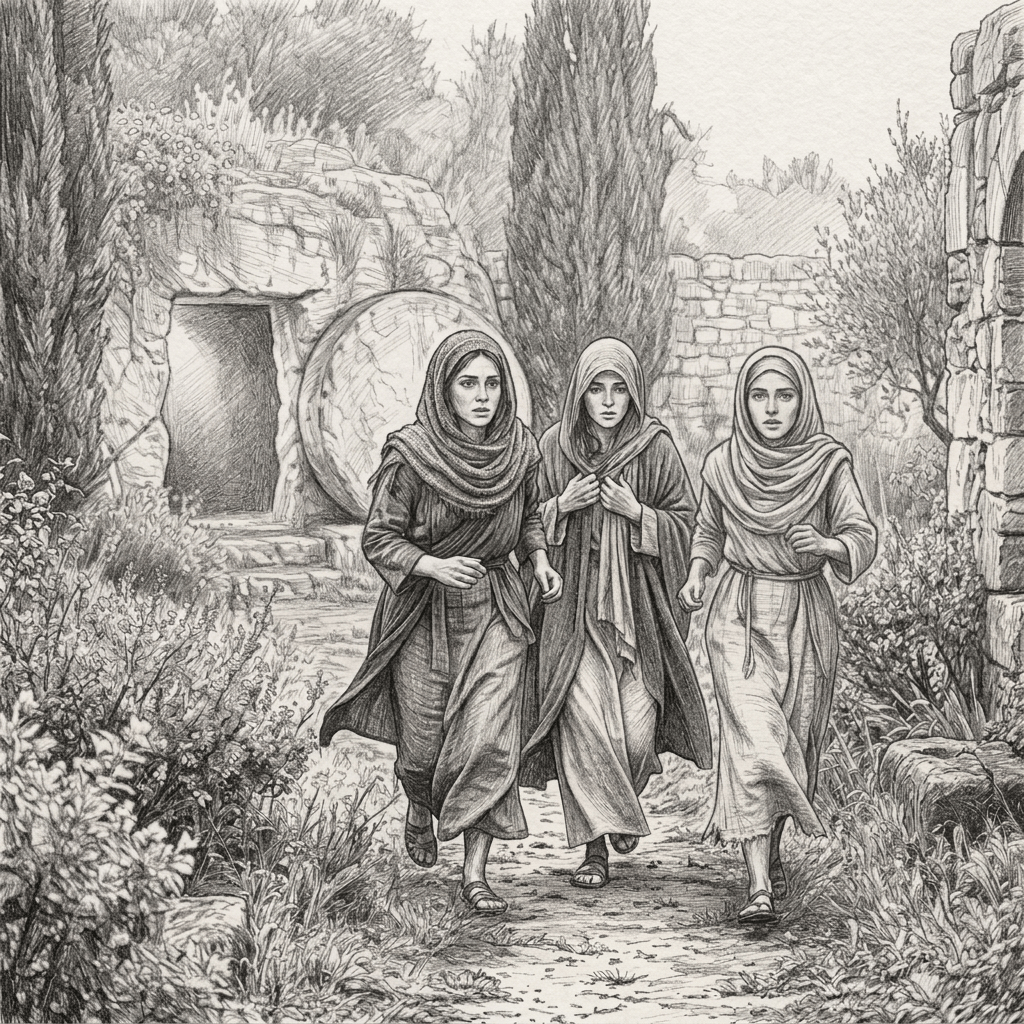
Mark’s Gospel, as a whole, is driven by urgency; it is the Gospel of “immediately,” characterized by rapid transitions and kinetic action. In comparing Mark’s description of certain events with the writings of Luke or Matthew, the brevity of his account is often noticeable. However, Mark’s description of the empty tomb does not continue at the same pace. The narrative description of the unnamed collective’s actions slows to consider their emotional response. He leaves the women trembling, in silence, outside the opened tomb. The Greek word Mark uses to describe their amazement is “ekstasis” – “a state where the mind is pulled out of its normal categories by sheer, unadulterated wonder.” Mark deliberately breaks his narrative to focus on their fear, reminding the reader that Jesus’s resurrection was a supernatural event. Death, always the one absolute of human history, had been shattered. The women had to process what they had witnessed before they could go and make a declaration to others. The pause in the narrative captures that need to process these events.
Now we will contrast the account in Matthew with Mark’s approach. Matthew’s account opens with explosive supernatural activity – an earthquake, an angel whose appearance was like lightning, and Roman guards frozen in terror. Then the angel speaks to The Unnamed Collective.
“And they departed quickly from the sepulchre with fear and great joy; and did run to bring his disciples word.”
Matthew 28:8
In Matthew’s account, when the angel speaks reassurance to the women and commissions them to go, Matthew records a profound psychological phenomenon: they departed “with fear and great joy; and did run.” Matthew does not describe a progression where fear gradually dissolves before joy can take its place. We often think about fear and joy as opposites. However, Matthew says that, for The Unnamed Collective, these emotions coexisted in the same space. The fear was entirely rational given the supernatural events they had witnessed; yet interwoven directly with that terror was an overwhelming joy at the resurrection of Jesus Christ. Disciples are rarely without fear or anxiety, but when the joy in Christ is greater than the fear, faith can guide our steps.
When read together, while the accounts create some contradictions that must be accepted, they also form a complete picture of spiritual discipleship. Mark provides the necessary internal depth: he insists that we must first feel the staggering weight of what Christ accomplished. We must never reduce the Resurrection to mere sentimentality. Matthew provides the external direction: he shows us that holy reverence must find action in the world. The climax occurs as the women return to the disciples.
“And as they went to tell his disciples, behold, Jesus met them, saying, All hail. And they came and held him by the feet, and worshipped him.”
Matthew 28:9
It was while they ran, both with fear and joy, that Jesus met them on the road. Their physical response to run and get back to the disciples gives way to their emotional and spiritual response to worship the Lord. Their stunned silence and their urgent running are left behind as they cling to the Lord and his grace.


Leave a comment