A note from the desk of our Pastor:
“Wives, submit yourselves unto your own husbands, as it is fit in the Lord.”
Colossians 3:18
“Husbands, love your wives, and be not bitter against them.”
Colossians 3:19
Good Morning Dearly Beloved,
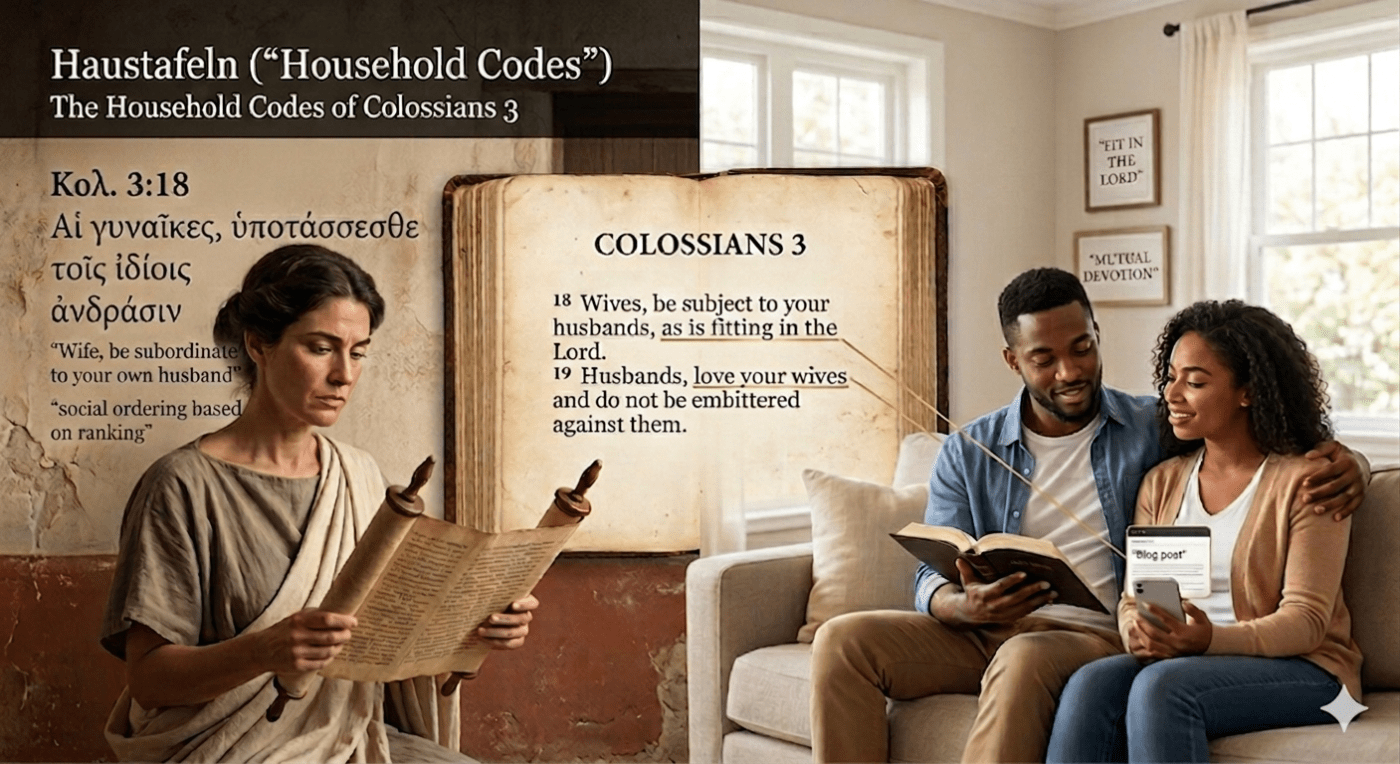
In the modern American landscape, Colossians 3:18 is often met with immediate tension. The word “submit” carries a heavy historical weight, frequently associated with inequality or the misuse of spiritual authority. In a culture that rightly values individual autonomy and dignity, Paul’s instruction can feel like a jarring relic of a patriarchal past. However, approaching the text solely through the lens of modern discomfort risks missing a revolutionary message. To truly understand this verse, we must look past 21st-century definitions and step into the rigid social hierarchy of the 1st-century Roman Empire.
When we examine the historical context, we find that Paul was not merely reinforcing the status quo; he was subverting it. By addressing wives directly as moral agents—a radical shift in a culture that viewed women as property—and grounding their actions “in the Lord,” Paul established a new boundary for authority. This “Household Code” shifted the believer’s primary allegiance from the Roman Pater Familias to Jesus Christ. By slowing down to study the original Greek and the reciprocal commands that follow, we discover a quiet revolution that began to replace ancient dominance with a life-giving order rooted in Christ.
Core to understanding verse 18 is an acknowledgment of 1st-century cultural expectations. The standard in virtually every culture of the day was that women, including wives, were inferior to men. In marriages, the culture required women to be submissive, even servile, to their husbands. The Apostle in this verse was not instructing women to submit to their husbands; he was acknowledging the societal expectation. Then he placed a boundary around that expectation. He told wives that their responsibility to submit to their husbands stopped where it violated the teachings and commandments of Christ. The Apostle’s instruction to the church was to grant power and authority to its female members.
Then, in verse 19, the Apostle follows with a limitation on husbands. Paul strips husbands of absolute societal power, grounding their authority strictly in the bounds of love. Husbands, following Christ, know that showing love as Christ modeled it requires sacrifice and empathy. The teaching effectively reversed the “rule of the husband” because he could no longer demand anything unloving or harmful, providing the wife with a scriptural basis to refuse treatment that was “bitter” or un-Christlike.
Ultimately, Colossians 3:18–19 transforms the home from a place of cultural hierarchy into a sanctuary of mutual devotion. By pairing the wife’s voluntary cooperation with the husband’s mandate for self-sacrificial love, Paul replaces ancient models of dominance with a partnership rooted in the character of Jesus. This reciprocal relationship ensures that authority never becomes tyranny and that service never becomes slavery.
When a household anchors itself in these verses, the primary goal shifts from maintaining social order to reflecting the Gospel. A Christ-centered home emerges when both partners prioritize their allegiance to the Lord over their own cultural rights. In this sacred space, love becomes the boundary and the bridge, creating a life-giving environment where every action is “fit in the Lord” and every interaction is seasoned with the grace of Christ.
Our Prayers are with you daily,
Brother Jeremiah


Leave a Reply